


A Review of CCNY's Theatre Production: "La Gringa"

By Sofia Peña
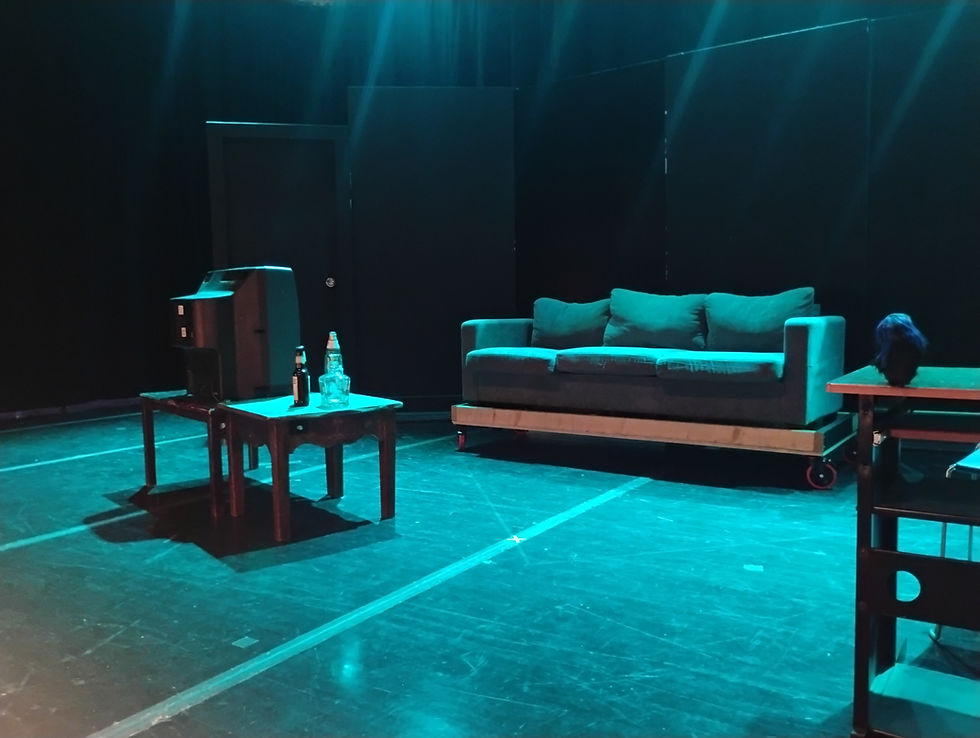
On the weekend of November 7th, 2025, the City College production of La Gringa brightened the black box theater at Aaron Davis Hall. Director Karina Verna, along with the actors, tackled the themes of Carmen Rivera’s Obie award-winning play with authenticity. In an interview for The Paper with Carmen Rivera, she praised the entire team for how well they supported one another, and the research they did for each of their characters. This was evident in the production, each performer giving justice to their respective roles.
La Gringa follows María, played by Raven Torres, a Puerto Rican-American woman on vacation visiting her family. She stays with her extended family as she hopes to connect with her culture and search for her identity. In the midst of her vacation, she decides to move to Puerto Rico permanently, but is met with constant conflicts regarding family feuds and being accepted within her culture. Carmen Rivera drew from experiences in her own life to create a beautiful play about identity, culture, and unfulfilled dreams. The CCNY production team performed the play with love and understanding of the theme's intensity, which cannot go unnoticed.
The actors devotion to the play is particularly evident through their presences as an ensemble. Even with only six characters, the family felt large and filled with love. Every moment they were staged together was enthralling, particularly due to the simple intimacy of the set. In keeping the kitchen (the main hub of character interactions) center stage, the audience was forced into the throws of their intense family dynamic and filled with love at moments of celebration. Even in the few times the family is together, your eyes are often drawn to Tía Norma, María's Aunt. In her portrayal of Tía Norma, Lia Garcia caught the audience's attention with her subtle physicality establishing herself as the matriarch of the household. The woman who calls the shots.
In the play, Norma holds onto the betrayal she felt when her sister, Olga, buried their mother in a town far from their own. During María’s visit, Norma projects this feeling onto her niece and is even against her visiting her grandmother's grave. Rivera notes that part of the work of an actor is “about analyzing your character journey, and also the story journey— How the arc of your character lives within the arc of the story, and how the arc of your story lives within the arc of your character.” It is in this sense that Lia Garcia shone. She had a deep understanding of Norma’s development throughout the play: from her standoff-ish attitude linking to her grudge with Olga, to a loving acceptance that extended to her whole family. Tía Norma’s arc was coherent and emotional, both of which I wish I had felt more of from the protagonist, María.
Raven Torres' acting was strong, particularly during her monologues. I must praise her ability to help the audience see the invisible; she painted beautiful imagery of beaches and coquís in such a way that allowed the audience to see the memories for themselves. However, there was some room for improvement in her performance — many of her scenes felt one-note. By this I mean that her shifts in objectives and development throughout the play were not presented clearly. Nothing changed about Maria's demeanor or authority as she connected with her roots. Instead, there was always a sense that Maria was still convinced she did not belong.
Even so, Torres connected well with the other members of the cast. María spends a lot of her time with her Uncle Manolo, played spectacularly by Eric Xavier Diaz, as he helps María connect with her Puerto Rican roots. It is clear how comfortable the actors were with each other, especially in how they carried the mentor–mentee relationship throughout the play. This is also due, in part, to how well Diaz presented Manolo.
Beyond his chemistry with the other cast members, I must specifically praise Diaz’s ability to portray pain throughout the play. Manolo is an elderly man who was overcome by a sickness that had left him bedridden until María came to visit. Diaz carries a limp that endures many different phases — sometimes it is subtle while others it is all you notice. This gives the audience an understanding of the development of his illness, and that some days the pain is far worse than others. This detail made Diaz stand out because carrying such a distinct physicality for the entirety of the play is not easy at all. It is a skill that must be rehearsed consistently, and mastered lest you break the illusion of an imaginary character.
Many of the successes of La Gringa can be attributed to the director, Karina Verna. When speaking with Carmen Rivera about the work she had done with Verna and the cast, she said, “When I saw the play, I felt I was watching my play for the first time.” Verna hoped that the CCNY Latino community would be able to connect with María’s journey, and that others are able “to find something new in a culture they didn’t experience before.” The team definitely achieved this goal. My deep emotional connection to this play made me skeptical when I learned about CCNY’s production, but Verna and the cast clearly connect with Rivera’s perceptive piece in the same way. I hope that is the standard for all future CCNY Theatre productions.

Sofia Victoria Peña is a second-year Psychology major with a minor in English. She is very excited to be joining The Paper as a Writer/Editor for her first semester at CCNY. She hopes to write about many different subjects and bring a new voice to The Paper. She’s thrilled to learn about publishing and the world of journalism while informing her peers at CCNY of topical matters. Some of her other passions include: reading, crocheting, theatre/acting, and animals.


Comments